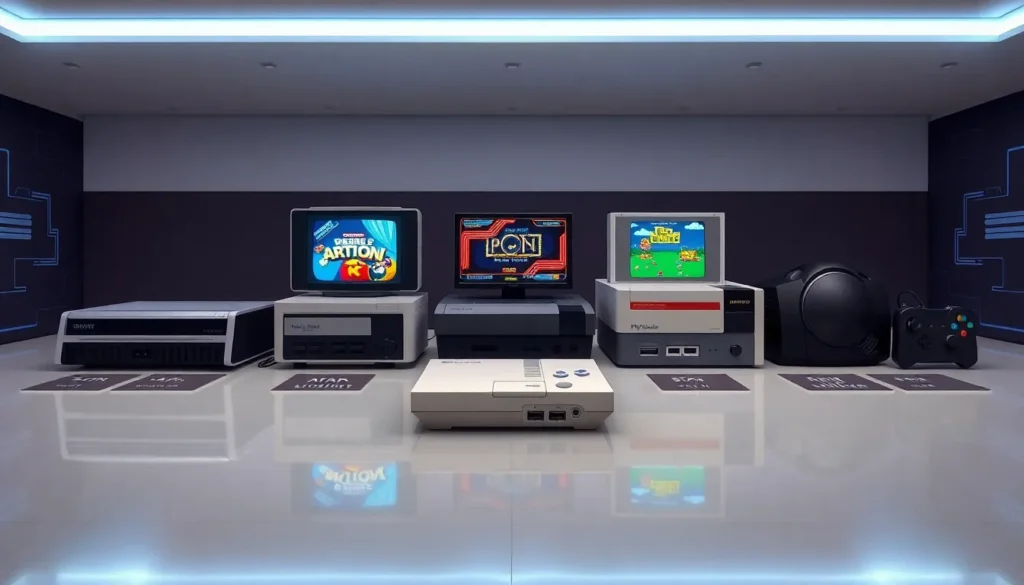
The path of gaming consoles is a fascinating journey, filled with innovation, competition, and technological marvels. From the early days of simple devices to the sophisticated systems of today, understanding the evolution of gaming consoles reveals much about gaming culture itself. In this text, we will explore all gaming consoles in order, charting their progression from the 1970s to the present and into the future.
The concept of gaming consoles began gaining traction in the early 1970s. The Magnavox Odyssey, released in 1972, is widely regarded as the first home video game console. This device utilized simple graphics and featured basic games like table tennis. Even though its limited capabilities, the Odyssey laid the groundwork for future gaming systems.
Gaming consoles were not just about games: they signified a cultural shift in entertainment, moving away from traditional board games and towards interactive experiences. As technology advanced, so did public interest in these new forms of entertainment.
The Early Years: 1970s to 1980s
The late 1970s to the early 1980s was a vibrant time for the gaming industry. Following the Odyssey, several other consoles emerged, including the Homepong and various systems from Atari. The Atari 2600, released in 1977, became particularly significant, popularizing cartridge-based games and establishing the video gaming market.
This era marked the rise of arcade games, which influenced home console design and gameplay styles. The introduction of games like Space Invaders and Pong showcased the potential of digital entertainment, leading to increased investments in gaming technology.
The Rise of 16-Bit and 32-Bit Consoles
The late 1980s and early 1990s introduced a new level of technological advancement with the rise of 16-bit and 32-bit consoles. Nintendo’s Super Nintendo Entertainment System (SNES) debuted in 1990 in Japan and gained a massive following.
The graphical capabilities allowed for more intricate games, creating iconic titles like Super Mario World and The Legend of Zelda: A Link to the Past. Sega followed closely with the Genesis, which featured its own noteworthy titles, such as Sonic the Hedgehog.
This era was marked by fierce competition, leading to significant improvements in gameplay and graphics. The battle for supremacy between Nintendo and Sega laid the foundation for future console wars.
The Transition to 3D Gaming: 1990s Consoles
The 1990s ushered in the era of 3D gaming, changing the landscape forever. Sony’s PlayStation, released in 1994, was a game-changer, offering players a new way to experience video games.
With its CD-ROM format, it provided larger storage capacity and stunning graphics. Titles like Final Fantasy VII and Metal Gear Solid showcased what 3D gaming could achieve, altering player expectations.
Meanwhile, Nintendo released the 64-bit Nintendo 64, featuring groundbreaking titles like Super Mario 64 that set new standards for 3D platforming. The competition between these platforms pushed further innovations in gaming technology, emphasizing the importance of immersive experiences.
The Sixth Generation: Modern Era Begins
The turn of the millennium brought about the sixth generation of gaming consoles. The release of the PlayStation 2 (PS2) in 2000 was particularly impactful, as it became the best-selling console in history. With backward compatibility and the ability to play DVDs, it attracted a broad audience.
Microsoft entered the fray with its Xbox in 2001, introducing online gaming through Xbox Live, which transformed how players interacted and competed. Meanwhile, Nintendo countered with the GameCube, which, even though its innovative design, struggled to compete with its counterparts.
This generation marked the rise of online gaming, shaping future expectations for multiplayer experiences.
Current Generation Consoles: 2020s and Beyond
The 2020s have seen the introduction of the ninth generation of gaming consoles, spearheaded by the Sony PlayStation 5 and the Microsoft Xbox Series X and S. These consoles offer significant improvements in processing power, graphics, and online functionality, enhancing user experiences dramatically.
Graphics engines now provide near photographic realism, and gameplay has become more immersive. The integration of storage solutions like SSDs has minimized load times, allowing players to enjoy a seamless experience.
Also, the introduction of services such as cloud gaming indicates a shift in how games are accessed and played, suggesting that future consoles will continue to evolve with these trends.
We use cookies on our website to give you the most relevant experience by remembering your preferences and repeat visits. By clicking “Accept”, you consent to the use of ALL the cookies.
This website uses cookies to improve your experience while you navigate through the website. Out of these, the cookies that are categorized as necessary are stored on your browser as they are essential for the working of basic functionalities of the website. We also use third-party cookies that help us analyze and understand how you use this website. These cookies will be stored in your browser only with your consent. You also have the option to opt-out of these cookies. But opting out of some of these cookies may affect your browsing experience.
Necessary cookies are absolutely essential for the website to function properly. These cookies ensure basic functionalities and security features of the website, anonymously.
Cookie
Duration
Description
cookielawinfo-checkbox-analytics
11 months
This cookie is set by GDPR Cookie Consent plugin. The cookie is used to store the user consent for the cookies in the category "Analytics".
cookielawinfo-checkbox-functional
11 months
The cookie is set by GDPR cookie consent to record the user consent for the cookies in the category "Functional".
cookielawinfo-checkbox-necessary
11 months
This cookie is set by GDPR Cookie Consent plugin. The cookies is used to store the user consent for the cookies in the category "Necessary".
cookielawinfo-checkbox-others
11 months
This cookie is set by GDPR Cookie Consent plugin. The cookie is used to store the user consent for the cookies in the category "Other.
cookielawinfo-checkbox-performance
11 months
This cookie is set by GDPR Cookie Consent plugin. The cookie is used to store the user consent for the cookies in the category "Performance".
viewed_cookie_policy
11 months
The cookie is set by the GDPR Cookie Consent plugin and is used to store whether or not user has consented to the use of cookies. It does not store any personal data.
Functional cookies help to perform certain functionalities like sharing the content of the website on social media platforms, collect feedbacks, and other third-party features.
Performance cookies are used to understand and analyze the key performance indexes of the website which helps in delivering a better user experience for the visitors.
Analytical cookies are used to understand how visitors interact with the website. These cookies help provide information on metrics the number of visitors, bounce rate, traffic source, etc.
Advertisement cookies are used to provide visitors with relevant ads and marketing campaigns. These cookies track visitors across websites and collect information to provide customized ads.


More Stories
Used Consoles: A Comprehensive Guide
Old Game Consoles of the 2000s
Xbox Consoles Timeline